Who Owns AI-Generated Content? Copyright & IP for Small Business
Who owns AI generated content copyright for a small business? A practical guide to owning, enforcing, and selling AI marketing copy, designs, and code.
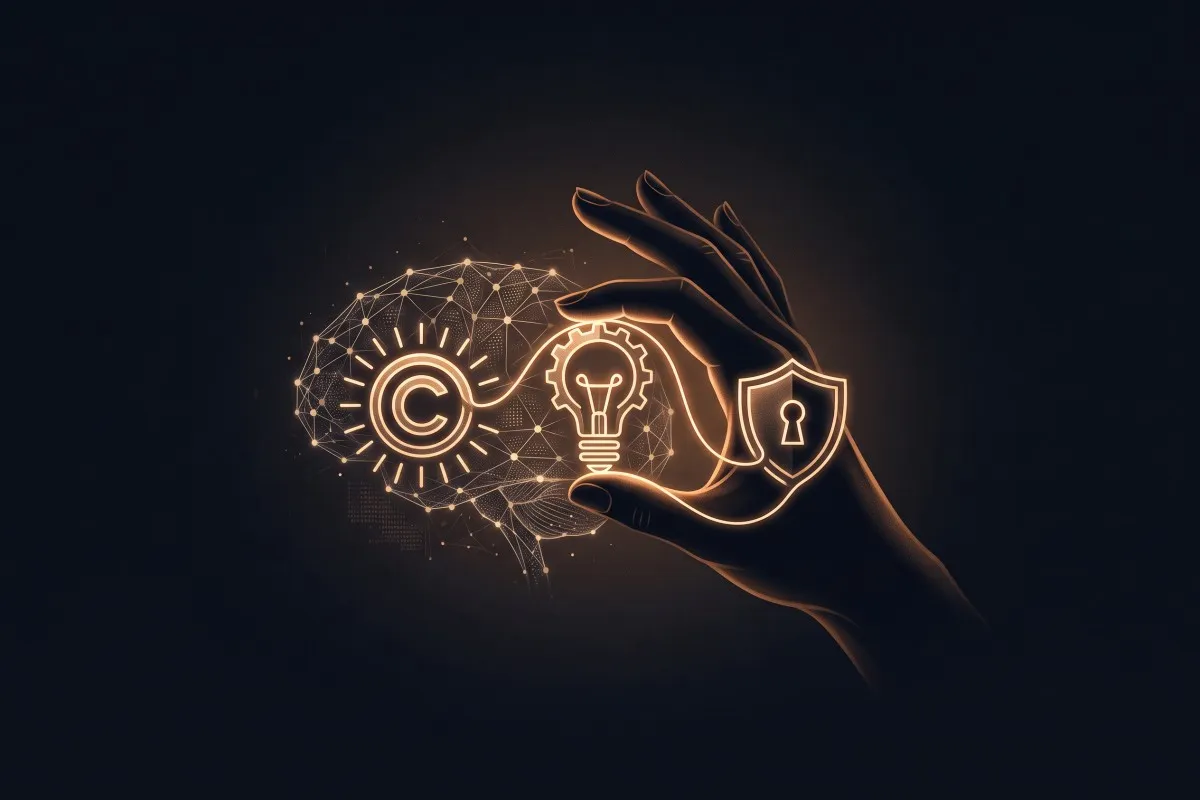
Here is the short answer. If a tool generated the work with no meaningful human creative input, no one holds a copyright in it, and that includes your business. The question of who owns AI generated content copyright for a small business turns on one fact: how much a person actually contributed. Copyright protects human authorship. Patents reward human inventors. Trade secret law is the outlier, because it does not ask who made the thing, only whether it has value and you kept it quiet.
That distinction decides whether you can enforce, sell, or license what your copywriting tool, image generator, or code assistant produced. Most owners assume the vendor’s terms settle it. They do not.
Who Owns AI-Generated Content? The Copyright Rule for Small Business
In January 2025 the U.S. Copyright Office published Part 2 of its report on copyright and AI, and the conclusion was blunt. Human authorship is a prerequisite, so a work generated entirely by AI is not copyrightable, and the mere selection of prompts, even detailed ones, does not by itself yield a protectable work. Where a person materially edits, arranges, or adds to AI output, those human contributions can be protected. The Office also requires applicants to disclose and disclaim any appreciable AI-generated material when they register.
The courts agree. On March 18, 2025, the D.C. Circuit in Thaler v. Perlmutter affirmed that an AI system cannot be the author of a work and that human authorship is a bedrock requirement. The Supreme Court declined to review the case in March 2026, leaving that rule firmly in place.
What does that mean for a business? The AI-only logo you planned to build a brand around may carry no copyright at all. A competitor could copy it, and you would have little to stop them. This is the ownership gap that sits underneath the fine print in our guide to AI tool licensing and IP rights: a vendor can assign you rights it does not actually hold.
Where the Line Falls Between Tool and Author
So the practical work is proving a human did enough. Editing, restructuring, or arranging AI output into something new can cross into protectable territory. Typing a prompt and taking the first result does not. Save your drafts and a dated record of every change. That trail is your proof.
Patents: The Invention Needs a Human Inventor
Patents run on the same principle, from a different agency. The USPTO’s inventorship guidance issued February 13, 2024 confirmed that AI-assisted inventions can be patented, but only when a natural person made a significant contribution to the claimed invention. Naming an AI as an inventor is not allowed. Merely owning the system, or overseeing it, or recognizing a useful output does not make you the inventor either. The person has to have contributed to the conception in a real way.
The agency revised that guidance in November 2025, easing some of the earlier test’s mechanics, but the core has not moved: patents exist to reward human ingenuity, and a human must have supplied it. For a small business, the takeaway is narrow and important. If an AI system designed your product feature end to end and no person meaningfully shaped the invention, there may be no valid inventor to name, and therefore no enforceable patent. This is the newest wrinkle on the older question we cover in the trademark, copyright, and patent guide.
Trade Secrets: The Protection That Ignores Who Made It
Now the useful part. Trade secret law does not require a human author or a human inventor. Under the federal Defend Trade Secrets Act, enacted May 11, 2016, information qualifies if it derives independent economic value from being secret and the owner takes reasonable measures to keep it confidential. That statutory test, codified at 18 U.S.C. § 1839(3), never asks whether a machine made the thing. It asks only about value and secrecy. So trade secrets have become an increasingly practical path for protecting AI-generated work, including proprietary datasets, tuned prompts, model configurations, and outputs you never publish.
The catch is confidentiality. A trade secret dies the moment it becomes public. So the marketing copy you post to the world cannot be a trade secret, but the pricing model, the customer segmentation, and the internal workflow behind it can be. What does “reasonable measures” look like for a small business?
- Access controls. Limit who can see the material, and use permissions rather than shared logins.
- Written obligations. Put confidentiality terms in employee and contractor agreements before the work starts.
- Handling rules. Mark sensitive files, keep them off personal AI accounts, and log where they go.
Trade secrets have no filing fee and no expiration. They last exactly as long as you keep the secret.
Can You Sell or License Output You Do Not Own?
Yes, with a clear-eyed caveat. You can transfer possession of a file, and you can grant a contractual license to use it, even when the underlying work carries no copyright. What you cannot do is stop a third party from copying an uncopyrightable output once it is public. The buyer gets the deliverable and whatever your contract promises. They do not get a monopoly the law never granted you.
This is where drafting earns its keep. If you sell AI-assisted designs, say plainly what you are transferring and what you are not, and price the exclusivity risk honestly. If you buy them, ask the vendor to represent the human authorship behind the work and to indemnify you if that turns out to be false. Contracts allocate risk that the copyright statute leaves open. And as IP enforcement broadens across 2026, the gap between “I possess this” and “I own this” is exactly where disputes start.
An Ownership Checklist Before You Build on AI Output
Run this before you make AI output central to a product, a brand, or a sale:
- Copyright. Did a person meaningfully create or shape the work, and can you prove it with saved drafts?
- Patent. If there is an invention, did a named human contribute to its conception, not just prompt or supervise the tool?
- Trade secret. Is the value in keeping it confidential, and have you actually restricted access?
- Contract. Do the vendor’s terms assign what they can, and do your sales terms describe what you truly own?
- Sensitivity. Should this work have touched a public AI tool at all?
Match the protection to the asset. A throwaway social caption needs none of this. A flagship design, a proprietary process, or a codebase you intend to license deserves every line.
The honest summary is that ownership of AI work is decided before you create it, not after a dispute begins. Get the human contribution, the confidentiality, and the paperwork right at the start, and most of these questions resolve themselves. If AI output sits at the center of your business and you are not sure what you actually own, a free initial consultation is the fastest way to map your specific assets to the protection each one can carry.
The information in this article is general in nature and does not constitute legal advice. Intellectual property questions are fact-specific; consult a licensed attorney to evaluate your particular situation.
Hook this up to your favourite commenting platform — Giscus, Disqus, or your own.
Continue reading
AI Tool Contracts and Small Business IP: 4 Clauses to Check
An AI tool contract quietly decides small business intellectual property rights. The four clauses to scrutinize before you accept any AI platform's terms.
Trademark vs Copyright vs Patent: A Small Business Guide
Trademark vs copyright vs patent for small business: which protection fits your brand, content, or invention — and what filing mistakes cost you thousands.
IP Portfolio Management for Small Business: The Full Lifecycle
IP portfolio management for small business: the maintenance fees, renewal windows, and recordation deadlines that kill patents and trademarks.